Wooden Montessori Activity Cube for Toddlers: Skill Play
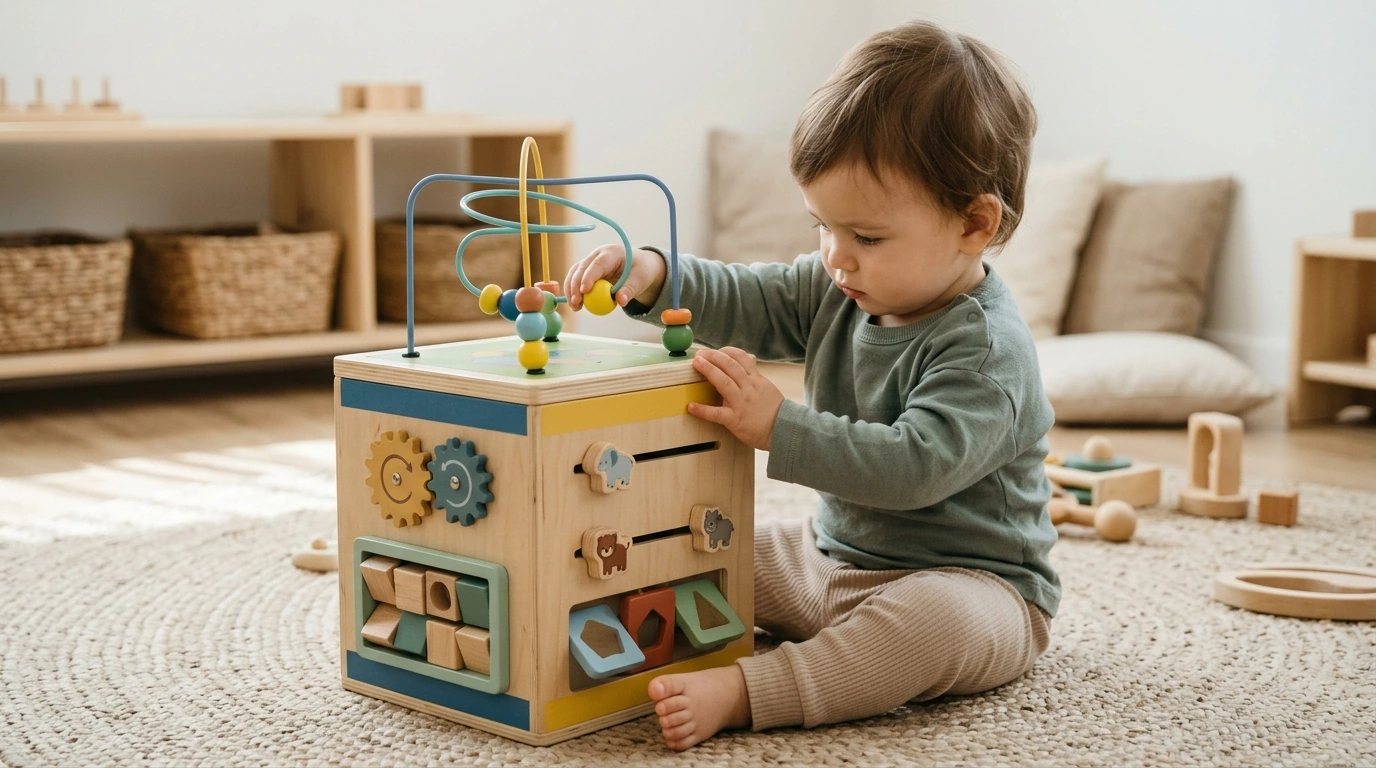
Wooden Montessori Activity Cube Toy for Toddlers: Hands-On Learning Through Play
A well-designed activity cube invites toddlers to explore with their hands, repeat actions, and build early problem-solving skills. This wooden Montessori-style cube offers multiple activities in one compact toy, supporting independent play while encouraging coordination, focus, and curiosity.
What It Is and Why Toddlers Love It
A wooden activity cube is a multi-sided toy with several hands-on “stations” designed for turning, sliding, matching, and manipulating. Because each side offers a different type of motion or challenge, toddlers can switch activities quickly—without needing a shelf full of separate toys.
Many children naturally gravitate toward repetition: they’ll spin a piece again and again, slide a track repeatedly, or try the same match until it clicks. That repeat-and-master pattern is part of what makes an activity cube so satisfying. It also tends to work well for quiet play in playrooms, toddler corners, and supervised floor time.
Key Skills It Can Support
Activity cubes are often chosen for their “learn-by-doing” value. With regular play, they can support multiple early-development areas toddlers practice every day:
- Fine motor development: grasping, pinching, rotating, and controlled finger movements.
- Hand-eye coordination: aligning pieces, tracking movement, and guiding hands using visual feedback.
- Early logic and problem-solving: experimenting with cause-and-effect and learning what “works.”
- Focus and persistence: quick cycles of challenge and success that help attention grow over time.
- Language-building opportunities: naming colors/shapes/actions and describing steps during play.
If you like to keep expectations realistic, it helps to remember that toddlers develop on different timelines. For milestone guidance by age, the CDC’s developmental resources are a helpful reference: CDC: Developmental Milestones.
Features to Look For in a Wooden Montessori-Style Activity Cube
Not all activity cubes are built the same. A few practical details can make a noticeable difference in how long a cube holds attention and how well it stands up to daily play:
- Smooth, rounded edges and sturdy construction for repeated use.
- Progressive activities that move from simple (sliders/spinners) to more complex (matching/sorting).
- A stable base to reduce tipping when toddlers lean in or pull on components.
- Easy-to-clean surfaces with finishes appropriate for children’s products.
- A balanced activity mix that includes open-ended exploration plus clear, solvable tasks.
For general toy safety considerations—especially around age-appropriateness and safe use—see: American Academy of Pediatrics: Toy Safety.
Activity Cube vs Other Toddler Learning Toys
Activity cubes combine multiple play patterns in one footprint, which can be a big win for small spaces. They also help keep play varied: when a toddler loses interest in one station, another side is ready without switching toys.
| Toy type | Best for | Typical play pattern | Good fit if your toddler… |
|---|---|---|---|
| Activity cube | Variety of fine motor + problem-solving | Moves between stations; repeats favorite actions | Gets bored quickly with single-purpose toys |
| Busy board | Latches, switches, practical-life motions | Opens/closes/toggles; role-play of real mechanisms | Loves doors, buckles, and “how it works” tasks |
| Shape sorter | Shape recognition + spatial reasoning | Match and fit shapes into slots | Enjoys clear goals and simple puzzles |
| Stacking/ring toys | Grip, sequencing, early size concepts | Stack, nest, and re-order | Likes repetitive building and knocking down |
Choosing depends on what your toddler is into right now: movement, matching, sensory exploration, or pretending to use “real-life” mechanisms. If you’re trying to keep toy rotation simple, an activity cube can cover a lot of ground in one purchase.
How to Use It for Meaningful Play (Without Overdirecting)
Montessori-style play tends to work best when the child leads and the adult sets up an inviting, accessible environment. A few small choices can make activity-cube play feel calmer and more purposeful:
- Set it on the floor or a low, stable surface so your toddler can approach independently.
- Demonstrate one simple action slowly, then pause and allow your child to take over.
- Use minimal language at first; add words after engagement (“turn,” “slide,” “in/out”).
- Rotate the cube’s orientation so different sides become the “front,” keeping interest fresh.
- Expect short sessions; frequent returns during the day can be more valuable than one long stretch.
Safety and Care Tips
For additional consumer guidance on safer play, the U.S. Consumer Product Safety Commission also maintains toy safety resources: CPSC: Toy Safety.
Product Snapshot: Wooden Montessori Activity Cube Toy for Toddlers
If you’re looking for a single toy that encourages hands-on learning through exploration and repetition, the Wooden Montessori Activity Cube Toy for Toddlers is designed to bring multiple early-learning activities into one compact cube. It’s a practical fit for playrooms and toddler-friendly spaces where independent play is encouraged.
- Girls Knit Sweater Dress with Heart Print & Ruffle Collar
- Kids’ 12V Ride On Land Rover with Remote Control and LED Lights
FAQ
What age is an activity cube best for?
Many activity cubes work well from late infancy through the toddler years, but readiness matters more than a number. Look for a design that matches your child’s current abilities and always follow the manufacturer’s age guidance with close supervision.
Are wooden activity cubes safe for toddlers who mouth toys?
They can be, as long as the cube is age-appropriate, has secure parts, and uses child-safe materials and finishes. Supervise play, avoid using any toy with damaged surfaces, and inspect regularly for loosened components.
How do activity cubes support Montessori-style play?
They encourage independence, hands-on learning, and repetition—letting toddlers try, adjust, and succeed through trial and error. Adults can support by setting up the space, observing, and naming actions as the child explores.








Leave a comment