AI Homework Help for Parents: A 10-Minute Rescue Routine
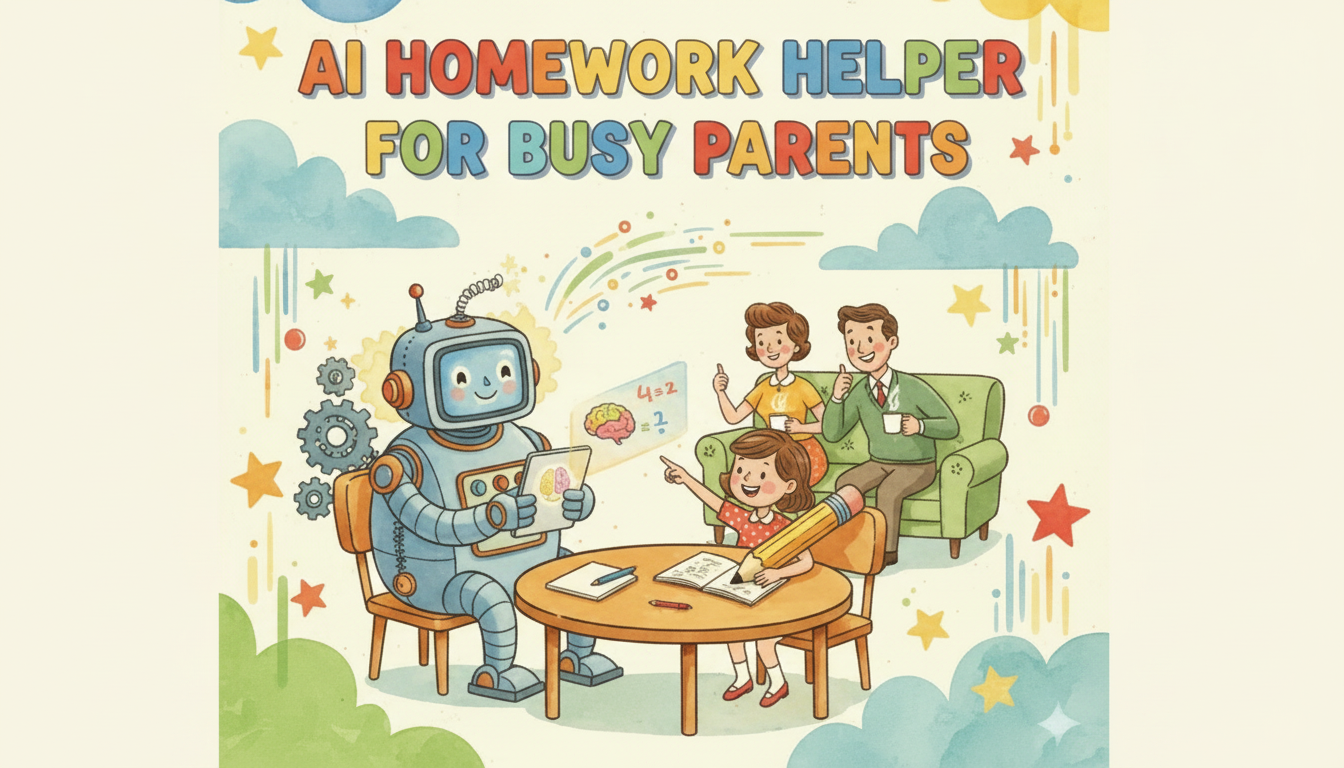
AI Homework Help That Builds Confidence (Without Doing the Work)
When homework suddenly feels harder than expected, it can turn evenings into a tug-of-war between time, patience, and confidence. A simple AI-supported routine can help parents stay supportive without doing the work for their child. This guide and a printable checklist (digital download) lays out a clear, repeatable process for using AI responsibly—so kids keep ownership of learning while parents regain a calmer, more predictable study rhythm.
If you want a one-page routine you can reuse across math, reading, and writing, the AI Homework Helper for Busy Parents printable checklist (digital download) is designed to keep help consistent, quick, and focused on understanding.
What an AI Homework Helper is (and what it isn’t)
An AI homework helper is best treated as a support tool—something that clarifies instructions, explains concepts in different ways, and generates extra practice without replacing the student’s thinking. It can act like a “tutor on demand” when a parent is juggling dinner, younger siblings, and deadlines.
What it isn’t: a shortcut for answers. The goal is understanding, showing work, and building independence. The most reliable results come from pairing AI help with a simple parent checklist so the steps stay consistent across subjects and caregivers.
For family-friendly guidance on responsible use, resources like Common Sense Media’s AI and education resources can help set expectations before homework time gets stressful.
A simple rule: help with the process, not the product
Before opening any tool, start with the assignment expectations: what must be turned in, whether work must be shown, if sources must be cited, and the required format. That “what counts” clarity prevents accidental rule-breaking and reduces redo work.
Then keep AI requests process-focused: ask for hints, steps, or a similar example—not the final response to submit. A helpful boundary is visible and repeatable: anything submitted should be written or solved by the student, with AI used for learning support only.
One habit that protects learning is the “kid summary.” After every AI explanation, have your child say (or write) one or two sentences in their own words explaining what they understood and what they’ll try next. If they can’t summarize, the help was too advanced—so scale down and ask for a simpler explanation.
The 10-minute rescue routine for “This is too hard” moments
When frustration spikes, long lectures rarely help. A short routine creates a calm reset without turning the night into a marathon.
Minute-by-minute reset
- Minute 1: Pause and scan—what part is confusing: directions, vocabulary, steps, or time pressure?
- Minutes 2–3: Rephrase the question together in simpler words; highlight key numbers/terms.
- Minutes 4–6: Ask AI for a concept explanation at the child’s grade level and one worked example that is not the same problem.
- Minutes 7–8: Child attempts the next step; parent checks only for direction (not correctness of every detail).
- Minutes 9–10: Ask AI to review the child’s work for errors and explain what to fix (without rewriting it).
This rhythm keeps momentum: AI explains, your child attempts, and feedback is used as coaching—not replacement. For a broader perspective on how AI is shaping learning (and where guardrails matter), the U.S. Department of Education’s AI guidance is a useful reference.
Ready-to-use AI questions that keep kids in charge
These question formats help your child stay the thinker and writer while still getting real support:
AI request ideas by subject (quick pick list)
| Subject | Helpful AI request | What the child must do next |
|---|---|---|
| Math | “Show the steps for a similar problem and explain why each step matters.” | Solve the assigned problem independently; compare steps |
| Reading | “List main idea, 3 supporting details, and 5 comprehension questions.” | Answer questions using the text; cite page/line if needed |
| Writing | “Suggest an outline and 5 topic sentences; do not write the full essay.” | Write the draft in own words; revise with feedback |
| Science | “Explain this concept with a simple experiment idea and safety notes.” | Write a brief explanation and connect to class notes |
| Social Studies | “Give a timeline and 5 key terms with simple definitions.” | Create flashcards; explain connections between events |
Using the printable checklist to keep nights consistent
For a ready-to-go routine, use the AI Homework Helper for Busy Parents | Printable Checklist | Digital Download. If your bigger challenge is managing after-school time, the Using AI to Organize Kids’ Schedule | Digital Guide for Parents can help create a simple plan that protects homework time without taking over the whole evening. And if supplies are constantly getting lost, a dedicated container like the Creative Hollow Star Desk Organizer – Pen & Brush Holder helps keep pencils, markers, and highlighters in one place.
Common pitfalls and how to avoid them
Clear boundaries matter. International guidance such as UNESCO’s recommendations for generative AI in education emphasizes responsible, transparent use—exactly the approach that keeps homework honest and confidence-building.
When to stop and contact the teacher
FAQ
Can parents use AI when a kid’s homework is too hard?
Yes—when AI is used to clarify directions, explain concepts, generate practice, and provide feedback while the child still completes and submits their own work according to class rules.
How can AI help without encouraging cheating?
Keep requests focused on the process (hints, steps, similar examples, and error-checking), and require your child to summarize what they learned and do the final work independently.
What should be shared (or not shared) with an AI tool?
Avoid sharing personal data (full name, school, address) or private class materials that aren’t meant to be uploaded. Share only the relevant problem text and your child’s attempt when needed.









Leave a comment