Talking to Toddlers About Emotions: Simple Scripts

A Parent’s Guide to Talking to Toddlers About Emotions (Without Turning It Into a Lecture)
Toddlers feel big emotions with small language skills. With a few simple habits—naming feelings, setting kind limits, and practicing calm-down tools—families can reduce meltdowns and build emotional skills that last. This guide focuses on practical phrases, routines, and quick scripts that fit real-life parenting moments. For more guidance, see The Children and Screens Guide for Child Development ….
Why toddler emotions look so intense
Toddler feelings can seem to arrive “out of nowhere,” but what’s really happening is development in progress. Their brains are still learning self-control, so emotions often show up faster than coping skills. For further reading, see Resources for Families: Supporting Your Child’s Growth.
- Self-regulation is under construction. A toddler may want to do the right thing, but their body can’t always slow down in time.
- Limited vocabulary adds pressure. Hunger, discomfort, and fatigue often spill out as anger or tears because “I’m overwhelmed and need help” isn’t easy to say yet.
- Transitions feel like losing control. Leaving the park, getting dressed, and bedtime can trigger intense protest.
- Sensory overwhelm is real. Noise, crowds, bright lights, or scratchy clothes can create sudden emotional spikes.
The goal isn’t “no big feelings.” It’s safer, shorter, more teachable moments—again and again—until skills take root.
Emotion coaching basics: the 3-step pattern
When you keep your words short and consistent, toddlers start to predict what happens next—and that predictability is calming.
- Notice and name the feeling: “You look disappointed.”
- Validate without giving in: “That’s hard. You really wanted more time.”
- Set a clear limit + next step: “It’s time to go. You can hold my hand or ride in the stroller.”
Keep your tone calm, your face soft, and your body steady. Try kneeling to their level, speaking slowly, and using the same script often—repetition is how toddlers learn.
What to say in the moment: short scripts that work
Long explanations can feel like noise to a dysregulated toddler. These short scripts do the job without turning the moment into a lecture:
- Anger: “You’re mad. Feet stay on the floor. You can stomp here.”
- Sadness: “You’re sad. Come close. Do you want a hug or space?”
- Fear: “That surprised you. I’m here. Let’s look together.”
- Jealousy: “You want my attention. I’ll finish this, then it’s your turn.”
- Overwhelm: “Too much. Let’s take a quiet break and breathe.”
- After the storm: “That was a big feeling. Next time we can say ‘help’ or ‘break.’”
Limits with empathy: how to say “no” without escalating
Empathy doesn’t mean avoiding boundaries. It means holding them with connection.
- Start with connection: get low, make eye contact, use your child’s name.
- State the limit once and repeat as needed without adding extra explanations.
- Offer two acceptable choices to restore a sense of control: “Walk or stroller?”
- Use “when/then” language: “When toys are put away, then we read a book.”
- Avoid questions when it’s not optional: “It’s time to…” rather than “Okay?”
- Follow through predictably with a calm voice and steady presence.
Build a feelings vocabulary in everyday life
Emotional skills grow best outside the meltdown. Label feelings during play, books, and regular routines.
- Label your own feelings: “I’m frustrated. I’m going to take a breath.”
- Use books, pictures, and pretend play to practice emotion names.
- Name body clues: “Your fists are tight—your body is telling you you’re mad.”
- Start with a small set: happy, sad, mad, scared, excited, tired, worried.
- Practice when calm: skills don’t install well mid-meltdown.
Quick feelings-to-phrases guide for busy moments
| Feeling | What it can look like | Helpful parent phrase | Child-friendly alternative |
|---|---|---|---|
| Angry | Hitting, throwing, yelling | “You’re angry. I won’t let you hit.” | “Mad!” |
| Sad | Crying, whining, collapsing | “You’re sad. I’m here.” | “Sad.” |
| Scared | Clinging, hiding, freezing | “That startled you. You’re safe.” | “Scary.” |
| Frustrated | Grunting, giving up, screaming | “That’s tricky. Let’s try together.” | “Help.” |
| Overwhelmed | Covering ears, running, tantrum | “Too much. Quiet break.” | “Break.” |
Calm-down tools toddlers can actually use
A “calm-down menu” works best when it’s tiny and practiced during peaceful moments.
After a meltdown: the repair and learning moment
A simple daily routine for emotional development
Digital guide highlight: structured support for real-life moments
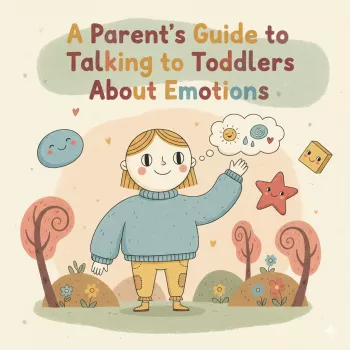
If it helps to have a quick reference you can revisit during busy seasons, A Parent’s Guide to Talking to Toddlers About Emotions (digital download) is designed to turn common power struggles—transitions, boundaries, sharing—into teachable emotional skills with ready-to-use scripts.
For comfort-focused routines (like a cozy calm-down corner or wind-down time), a soft, familiar outfit can also support the “settle” cue—see the Girls Knit Sweater Dress with Heart Print & Ruffle Collar.
FAQ
At what age can toddlers understand emotions?
Recognition starts early, but clearer understanding grows from about 18 months through age 3 and beyond. Simple labels (“mad,” “sad”) plus repeated modeling and practice help toddlers connect feelings with words and actions over time.
Does talking about feelings make tantrums worse?
Long explanations during a tantrum can escalate things, but short naming + validation + a clear limit usually helps reduce intensity over time. Save most teaching for after your child is calm, and use fewer words at the peak.
What if my toddler hits when they’re angry?
Block the hit calmly, state the limit (“I won’t let you hit”), and offer a safe outlet (“You can stomp or squeeze a pillow”). After calm, practice a replacement phrase (“Help” or “Break”) and guide a simple repair like a gentle touch or saying “sorry” in your family’s style.








Leave a comment